The Presidents by Stephen Graubard
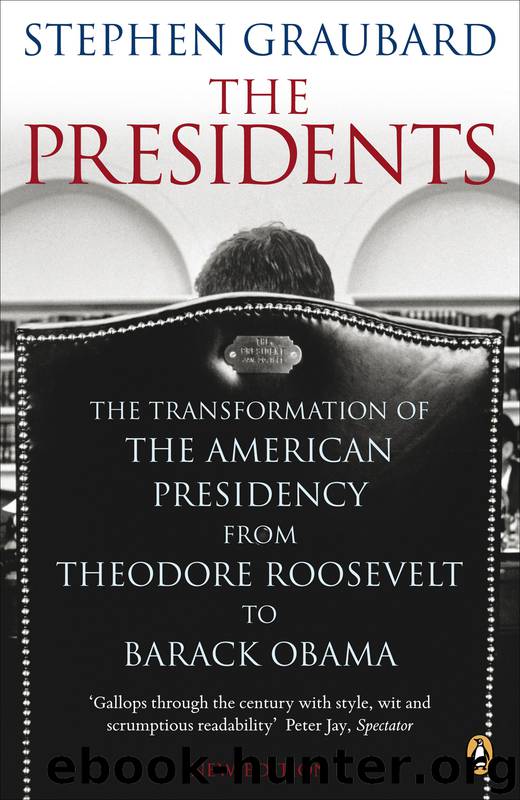
Author:Stephen Graubard
Language: eng
Format: epub
ISBN: 9780141042909
Publisher: Penguin Books Ltd
Published: 2009-10-31T16:00:00+00:00
The newly inaugurated president sounded the same note. Recalling Franklin Roosevelt’s problems created by the Great Depression, he contrasted the material needs of that day with those he confronted, saying, ‘Our crisis today is in reverse… We are caught in war, wanting peace. We’re torn by division, wanting unity. We see around us empty lives waiting fulfillment. We see tasks that need doing waiting for hands to do them. To a crisis of the spirit we need an answer of the spirit.’ In words that seemed to mock the whole of his tempestuous political career, he added: ‘When we listen to the better angels of our nature, we find that they celebrate the simple things, the basic things – such as goodness, decency, love, kindness.’47 Though the theme of spiritual revival dominated the occasion, the president spoke also of more mundane matters – the need for full employment and better housing, the rebuilding of the nation’s cities, protection of the environment – all issues his predecessor had made central to his presidency. On the crucial issue of the Vietnam War, he borrowed from Saint Francis of Assisi, saying, ‘Let us take as our goal where peace is unknown, make it welcome; where peace is fragile, make it strong; where peace is temporary, make it permanent.’ Quoting from the liberal poet Archibald MacLeish, he ended with: ‘Our destiny offers not the cup of despair, but the chalice of opportunity.’48 The rhetoric was not stirring in the Kennedy tradition, but it suggested a wish to be thought something other than a red-baiting firebrand.
The Cabinet he appointed, neither less nor more distinguished than the one chosen by Kennedy, included William Rogers, his longtime friend and adviser, as secretary of state. No one foresaw that the rivalry between Rogers and a Harvard professor of government, Henry Kissinger, chosen as the president’s national security adviser, would soon cause Rogers to lose much of his authority, suffering the same indignities experienced by Rusk under Kennedy, compelled to compete for the president’s ear with Bundy and the president’s brother. Nixon, like Wilson, Roosevelt, and Kennedy, intended to be his own secretary of state, consulting and using only those he believed might contribute to his success. For him, as for Roosevelt, the State Department could offer little. Imagining himself extraordinarily endowed as an expert in foreign affairs, knowing but never acknowledging the ineptitude of Eisenhower, whom he had observed closely, and having little regard for Kennedy or Johnson, he found only one interlocutor, the man he scarcely knew, Kissinger, as the person to consult with. Nixon simply perpetuated the control of foreign policy in the White House that his Democratic predecessors had initiated.49
As attorney general, he chose the dour John Mitchell, another old friend who resembled Robert Kennedy only in his total commitment to the president, ready to do anything to assist him, the ever-reliable adviser, useful in numerous roles other than those that fell strictly within his Department of Justice jurisdiction.50 In the White House, with a
Download
This site does not store any files on its server. We only index and link to content provided by other sites. Please contact the content providers to delete copyright contents if any and email us, we'll remove relevant links or contents immediately.
| Africa | Americas |
| Arctic & Antarctica | Asia |
| Australia & Oceania | Europe |
| Middle East | Russia |
| United States | World |
| Ancient Civilizations | Military |
| Historical Study & Educational Resources |
Cat's cradle by Kurt Vonnegut(15293)
Pimp by Iceberg Slim(14461)
4 3 2 1: A Novel by Paul Auster(12352)
Underground: A Human History of the Worlds Beneath Our Feet by Will Hunt(12071)
The Radium Girls by Kate Moore(12000)
Wiseguy by Nicholas Pileggi(5740)
The Fire Next Time by James Baldwin(5407)
Perfect Rhythm by Jae(5382)
American History Stories, Volume III (Yesterday's Classics) by Pratt Mara L(5283)
Paper Towns by Green John(5157)
Pale Blue Dot by Carl Sagan(4978)
A Higher Loyalty: Truth, Lies, and Leadership by James Comey(4937)
The Mayflower and the Pilgrims' New World by Nathaniel Philbrick(4474)
The Doomsday Machine by Daniel Ellsberg(4471)
Killers of the Flower Moon: The Osage Murders and the Birth of the FBI by David Grann(4423)
The Sympathizer by Viet Thanh Nguyen(4369)
Too Much and Not the Mood by Durga Chew-Bose(4316)
The Borden Murders by Sarah Miller(4297)
Sticky Fingers by Joe Hagan(4167)
